

Old Testament, Law
Genesis
Genesis begins the biblical story. It tells of God creating the world and humanity, of sin entering human life, and of a family—Abraham, Isaac, Jacob, and Joseph—through whom God makes promises of land, offspring, and blessing. The book moves from the origins of the nations to one household, and it ends with that household in Egypt.
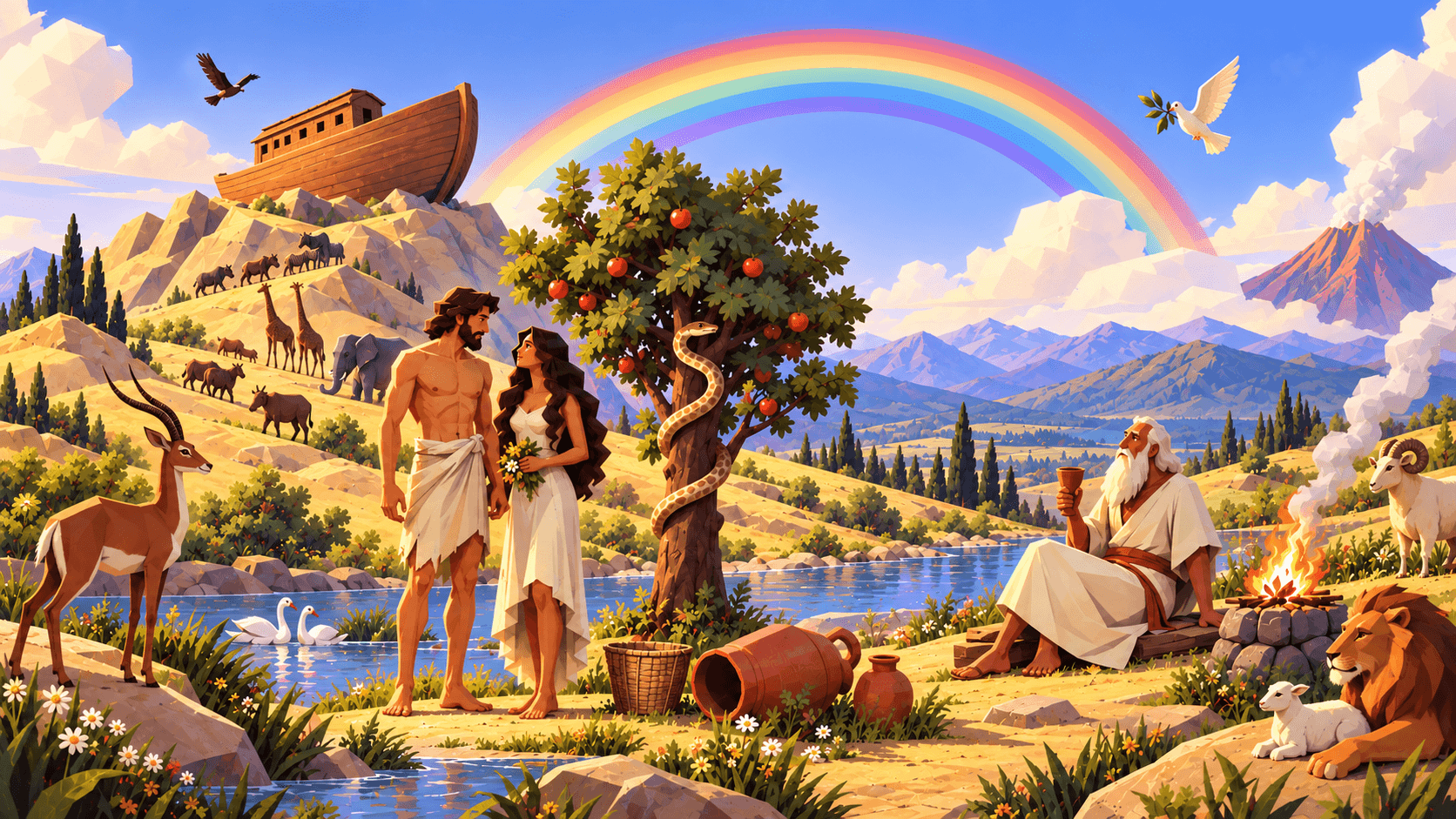
The book at a glance
- 1–11
Primeval history
Creation, the spread of sin, the flood, and the nations.
- 12–25
Abraham
The call of Abram, the covenant promises, and the birth of Isaac.
- 26–36
Isaac and Jacob
The promise continues through Isaac’s household and Jacob’s family.
- 37–50
Joseph
Joseph in Egypt, and the preservation of Jacob’s household.
Before you read
Genesis is narrative. The first eleven chapters move quickly across creation, the spread of human violence, a flood, and the scattering of peoples. From chapter 12 the pace slows and follows one family. The book is not a modern science report, and it is not a complete history of the ancient world.
A thread of promise runs through the stories. God speaks. People respond in trust or failure. The promise is then repeated to the next generation. Genealogy lists mark new sections, and a few speeches near the end break into poetry.
You can read straight through. The chapter list groups the book into four movements, so you can also begin with Abraham, with Jacob, or with Joseph.
Historical and literary context
Historical context
The later chapters are set among the clans, towns, and journeys of the ancient Near East, especially Canaan and Egypt. The opening chapters are set before those particular nations exist. Jewish and Christian tradition has received Genesis as the first book of Israel’s Scriptures and as part of the Law associated with Moses.
The narratives assume agreements between families, movement between regions, and an Egypt able to hold a foreign household. Genesis does not date its events on a modern calendar. Proposals for when Abraham lived, or for how the opening chapters relate to the age of the earth, are interpretations brought to the text. They are not dates printed in the book.
Authorship
Jewish and Christian tradition has long attributed Genesis, with the rest of the Pentateuch, to Moses. Many churches still teach the book that way. That traditional attribution should be named plainly.
Many modern scholars argue instead that Genesis reached its present form through a longer history of writing and editing, and that the book as we have it is later than Moses. Those proposals do not all agree about sources, dates, or editors. The debate is real. This introduction does not treat traditional Mosaic authorship, or any one academic reconstruction, as a closed case.
Composition
Genesis is mostly Hebrew narrative prose. It also contains genealogies and a few poetic speeches, including blessings near the end of the book. A repeated formula, often translated “these are the generations of,” marks major sections in the Hebrew text.
A common literary division separates chapters 1–11, sometimes called the primeval history, from the ancestral stories in chapters 12–50. That division follows the shape of the narrative. It is a reading aid, not a claim that the sections had different authors.
When the book was written is disputed. The traditional position places the writing in the time of Moses. Many academic proposals place the final form of Genesis in the first millennium BC, often in or after the Babylonian exile. Those are positions in a debate, not established dates this introduction can demonstrate.
Deeper study
Three ways of reading Genesis 1–2
An orientation to young-earth creationism, old-earth creationism, and literary readings of the creation accounts.
Christians who treat Genesis as Scripture disagree about how the first two chapters relate to the age of the earth and to scientific accounts of origins. The disagreement is interpretive. It is not a laboratory result, and it is not a single scholarly consensus this page can cite.
Young-Earth Creationism
Young-earth creationism is a traditional theological position. It reads the days of Genesis 1 as ordinary days and understands creation as recent, often on the scale of thousands of years. That is a decision about how the chapter’s chronology should be heard. It is not a measurement stated in Genesis.
Old-Earth Creationism
Old-earth creationism is also a theological position. It affirms God as creator and allows a much older earth, often by reading the days as long ages or by treating the chapter’s sequence as something other than a modern timeline. The timescales associated with that view are not stated in Genesis.
Literary Interpretations
Literary readings treat Genesis 1–2 chiefly as carefully ordered theological narrative: who God is, what creation is for, and where humanity stands. They often notice the repeated day formula and the two portraits of creation in chapters 1 and 2. These readings disagree among themselves about how much chronological sequence remains. Calling a reading literary does not decide whether the events happened.
The text itself presents God as the one who brings the world into being, humanity as made for relationship with God, and the created world as good. Historical evidence outside the Bible for the days of Genesis 1 is not inventoried here. Traditional positions and disputed interpretations stay labeled as such so the chapters can be read on their own terms.
Questions to consider
How should Genesis 1–2 be read in relation to the natural sciences?
Young-earth creationism, old-earth creationism, and literary readings are introduced above. They are theological and interpretive positions. Genesis does not mention modern geology or biology.
How do the flood and Babel stories relate to other ancient Near Eastern texts?
Readers have long compared these chapters with other ancient flood and city stories. What those comparisons imply for the meaning or origin of Genesis is disputed. This introduction does not summarize a particular archaeological report.
Are Abraham, Isaac, and Jacob historical individuals?
The book presents them as ancestors in a family history. Traditional reading receives that presentation as historical. Some historians regard the ancestral narratives as later theological storytelling and note that the individual patriarchs are not confirmed by surviving records outside the Bible. External evidence on this point is limited, and the historical question remains disputed.
What do the promises of land, offspring, and blessing mean?
Inside Genesis the promises are spoken to Abraham and repeated to his family. Later Jewish and Christian readers connect them to the rest of Scripture in different ways. Those connections are interpretations of the wider canon.